


Kevin D. Klipstein steps down this week from his role as President and Chief Executive Officer of US Squash. His twenty-one-year and two-month tenure has been marked by watershed changes throughout the organization and in the game both nationally and globally.
Klipstein grew up playing squash in Rochester, NY. He played varsity squash at Cornell University, serving as a captain his senior year when he was recognized as an All-American. Working in a variety of roles after college, first in Seattle, Washington, D.C. and finally the San Francisco Bay Area, he did corporate consulting at the sports marketing firm ProServ, including working at the America’s Cup in New Zealand and then marketing for Sun Microsystems, managing sponsorships with Formula 1, the National Hockey League and Major League Baseball.

He became the organization’s fourth executive director in December 2004, just two months after the association had celebrated its centennial. Since then, Klipstein led wholesale changes. In 2006, after thirty-two years in Philadelphia, the United States Squash Racquets Association (USSRA) headquarters moved to 38th and Eighth Avenue in New York.
“When Kevin started, it was a bit of a mom-and-pop operation,” said Gilly Lane, a former Team USA player and the men’s coach at Penn. “He turned it into a professional organization. He had a belief that we needed to be a world-class governing body. His skill set was perfect for focusing on that growth.”
A year later, the name of organization went from the USSRA to US Squash and the logo evolved. These were symbolic and tangible gestures. Klipstein modernized the brand and took the organization out of its comfortable home in the Philadelphia suburbs and transplanted it in the biggest city in the country; US Squash was the first national governing body to be headquartered in Manhattan. He also quadrupled staff; at one point two dozen employees worked full-time in New York.
Klipstein initiated a thorough governance restructuring. He changed the board from a regionalized system where each local district chose its own representative to a national board that selected itself. His title evolved from Executive Director to Chief Executive Officer, adding the title of President a decade later, given the international aspects of his work.
“I met Kevin twenty years ago when he asked for help with governance,” said Carey Anderson, a long-time US Squash board member. “Kevin was wise beyond his years, calm under pressure and creative without needing the spotlight. He was like Wayne Gretsky—he could see the whole thing, the entire ice rink, the outcomes. His fingerprints today are on everything that matters.”

Instead of outsourcing digital tournament and ranking technology, Klipstein started Club Locker in 2014. A proprietary sports management software system, Club Locker is an all-in-one platform designed to power every aspect of the racquet sports experience. From player ratings and tournament management to membership integration, facility operations, live streaming, and payment processing, Club Locker today provides a connected ecosystem that supports over 4,000 facilities and hundreds of thousands of players, coaches, parents and administrators across the squash world. In 2025, US Squash spun Club Locker off, selling a majority stake to Artisan Ventures to ensure it has the resources and focus required to thrive and grow as a software company, all to the benefit of US Squash.

Bringing the game in-house was a constant theme under Klipstein’s leadership. “Always on the podium” was a motto of Klipstein’s. Instead of hoping Americans get there, with funds raised from a 2008 gala dedicated to the national team, he initiated the Elite Athlete Program—the precursor to today’s High Performance Program—which supports Team USA’s professional athletes. The first two athletes who started to receive direct financial support were Todd Harrity and Amanda Sobhy.
“I was concerned they wouldn’t be able to afford to compete professionally without this crucial support,” Klipstein said.
As early as 2008, Klipstein made the decision to fully fund the junior national teams competing in World Championships. Previously each team member had to pay their way, with some having to conduct their own fundraising campaigns to cover the costs. In the same year, he also brought on Paul Assaiante, the winningest college coach of all-time, to serve as the first Ganek Family US Squash Head National Coach; Assaiante served in the role for thirteen years.
In 2013, US Squash purchased the national monthly Squash Magazine, based in Seattle, and incorporated its staff, including editor Jay Prince, into the operations in New York. US Squash began to directly run all national championships, everything from the U.S. Junior Open to the National High Schools Championships, now the world’s largest team event. It took over the United States Open and in 2011 brought it back to Philadelphia when John Fry, the president of Drexel, helped stage it in Drexel’s basketball arena. The Open spent nine straight years at Drexel, the longest it had ever been staged at one place. It again became one of the world’s Grand Slam events, with top prize money, attention and event production. The 2011 prize money of $175,000 ($115,000 to the men, $60,000 to the women) was the largest purse in Open history and only the second time that the men and women had played side-by-side in the Open, after the 1993 event hosted at Cynwyd Club. The U.S. Open at Drexel again changed the squash landscape. It became the most saturated pro event, with nearly a fortnight of adjacent tournaments, award celebrations, panel discussions, Hall of Fame inductions, meetings, clinics and film festivals.

The Open led directly to the fulfillment of the long-held dream of a national headquarters for the national governing body. “We had met in 2006 when Kevin came out to Lancaster to talk about a national headquarters,” said John Fry, who was at the time the president of Franklin & Marshall. “Kevin’s like a dog with a bone—if it is a good bone, he won’t let go.”
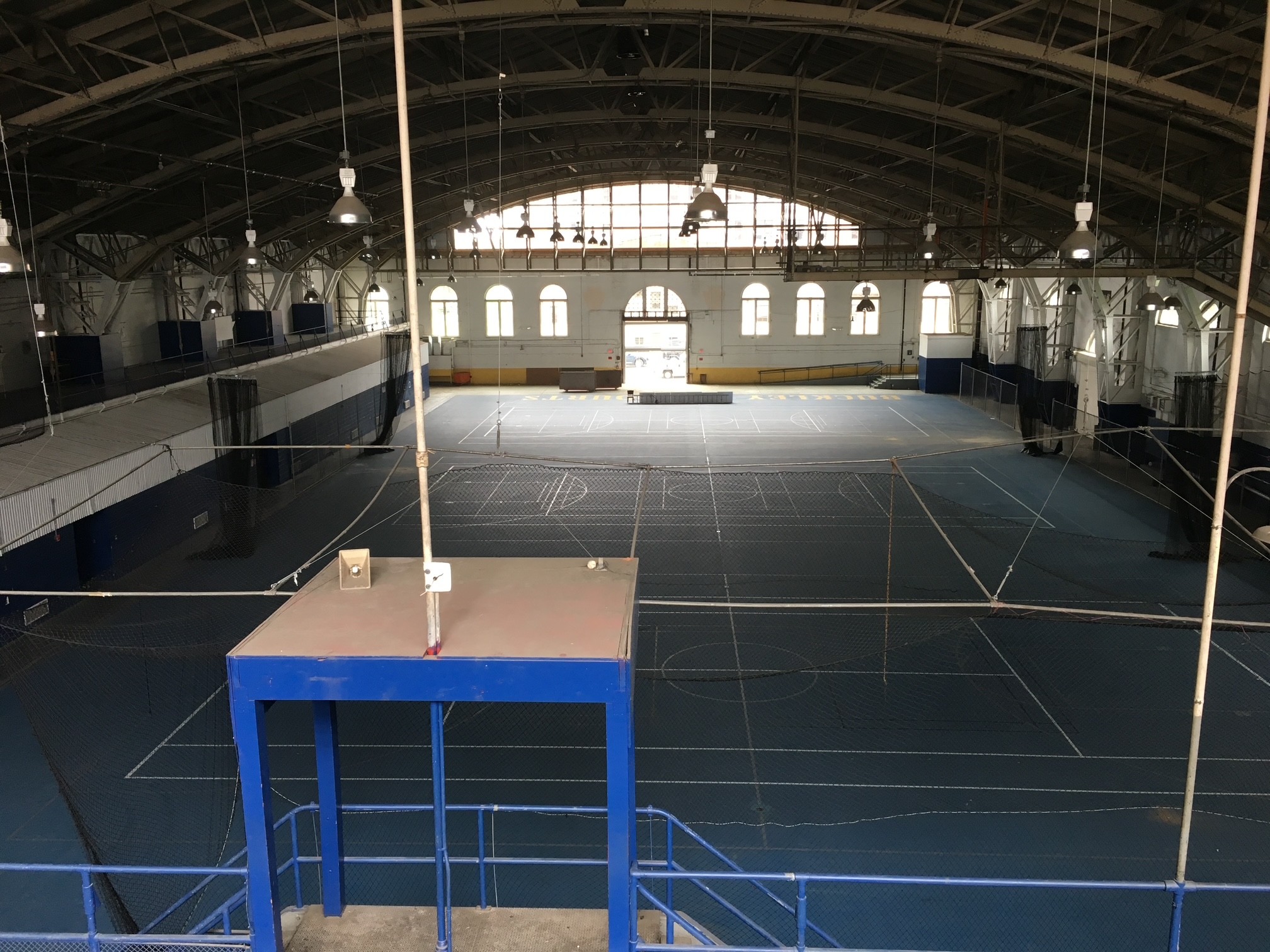
Across 33rd Street from the basketball arena was the Philadelphia Armory, a historic 1916 building. In 2017, Klipstein partnered with Ned Edwards, a U.S. Squash Hall of Famer, to jumpstart the fundraising required to get the board’s green light for the project. Edwards was then hired as the first Executive Director of the Arlen Specter US Squash Center and by November 2019 construction began at the Armory to build the $40 million facility. The Specter Center opened in October 2021 as the world’s largest community squash center. It features 75,000 square feet of office space, a conference room, locker rooms, classrooms, displays, kitchens, gathering spaces, gym and US Squash’s archive. A highlight was the Pierce Family U.S. Squash Hall of Fame, the mezzanine’s centerpiece. The heart of the Specter Center is eighteen singles courts and two doubles courts; two of the singles courts are all-glass exhibition show courts. Because of Drexel’s seven courts and Penn’s twelve courts, there are now thirty-seven singles courts within a five-minute walking radius—the largest squash district in the world, with 33rd Street officially designated “Squash Way” by the City of Philadelphia in 2022.
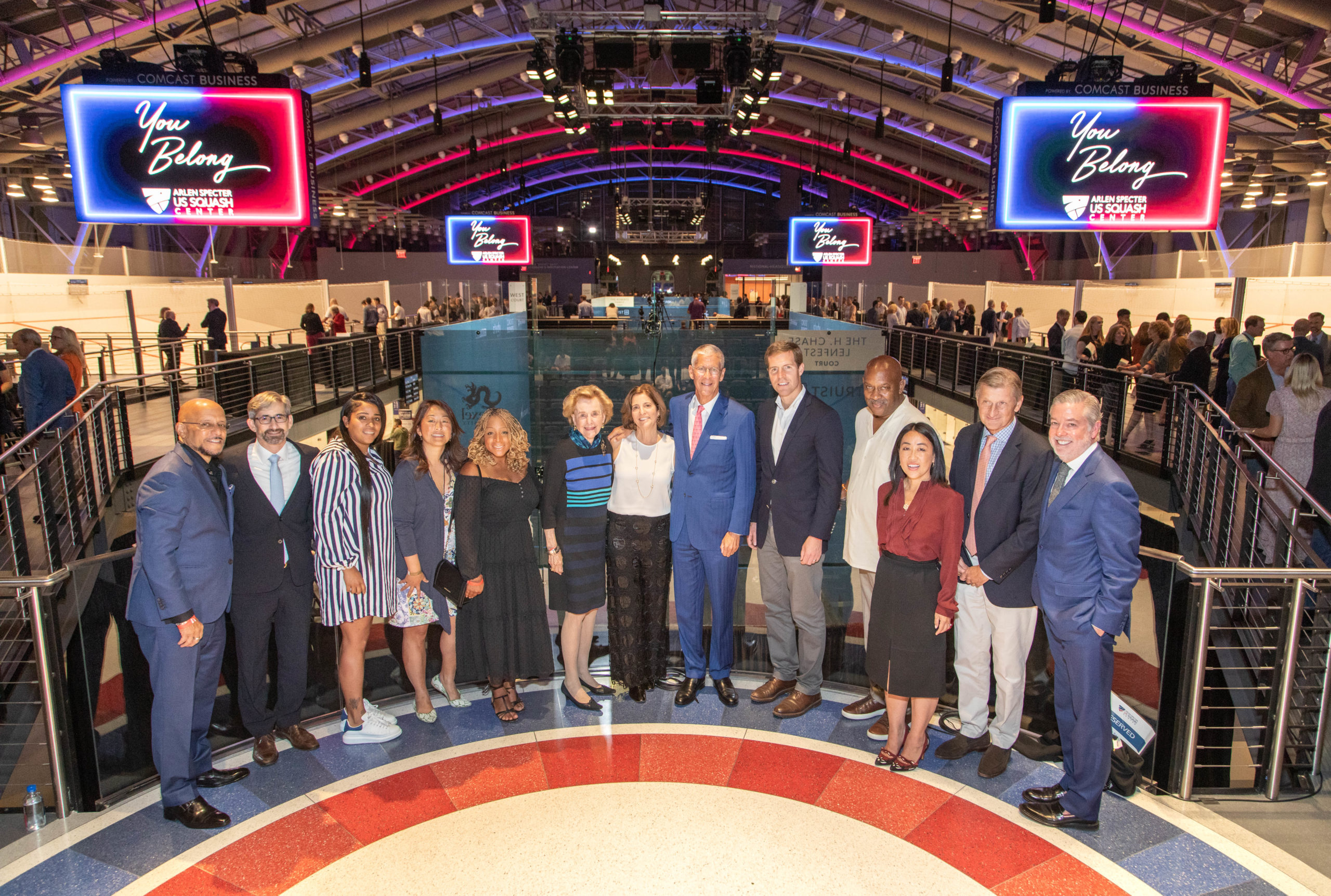
When US Squash hosted the 2021 U.S. Open in the Specter Center, it was the first time a public squash club had ever hosted the venerable tournament. It also had prize-money parity. That was automatic because of a decision eight years earlier. Led by Klipstein, the 2013 U.S. Open offered the same amount of money to women and men, becoming the first major annual squash tournament to ensure equality.
Like with many decisions that Klipstein made, prize-money parity had global ramifications. Within two years, all major pro squash events had prize money parity. Perhaps the most symbolic moment of the new era of parity came on a Saturday in 2017 when Nour El Tayeb and Ali Farag won their U.S. Open draws in back-to-back finals. It was the first time in squash history that a married couple won the same title on the same day. Parity directly led the way for the women’s and men’s tours to merge in January 2015. It was the first time two gendered tours had combined in a leading professional sport. Ninety years after the PSA tour was originally founded in Boston in 1925, pro squash was now grounded in equality. The merger led to tremendous growth, especially in the U.S.; by the end of Klipstein’s tenure, more than a third of all pro singles tournaments and prize money was in America.

US Squash in turn became a global leader. It hosted the World Squash Federation’s Annual General Meeting in Philadelphia in 2014 and helped stage numerous world championships, including the World Juniors in Boston in 2011 and Houston in 2024, the World Masters in Charlottesville in 2018; and the World Championships, for men in Seattle in 2015 and for both women and men in Chicago in 2019, 2021, 2023 and 2025; and the Men’s World Team Championships in 2019. In addition, the U.S. hosted several international multi-sport events that featured squash: the Gay Games in Chicago in 2006 and Cleveland in 2014; the 2022 World Games in Birmingham, Alabama; and the 2024 Pan American Masters Games in Cleveland. All these events were galvanic for American squash, garnering media attention and exposing the country to the highest level of squash excellence.
Klipstein also focused on synergies and collaborations to maximize efficiencies. US Squash directly partnered with dozens of organizations including the World Squash Federation (WSF), Pan American Squash Federation, Professional Squash Association (PSA), the Squash Doubles Association and the U.S. Jesters.
Two important partnerships, with urban squash and college squash, helped define Klipstein’s tenure. In 2006, Klipstein was at the table when the then-National Urban Squash and Education Association (NUSEA) was formed, formally titled “NUSEA in partnership with US Squash” due to the $100,000 in seed funding US Squash provided to the new entity for grants to new programs. NUSEA later changed its name to the Squash + Education Alliance (SEA). For nearly two decades, Klipstein has served on the SEA board as it has scaled from a network of four programs to more than twenty nationally and a half dozen international partners.

With college squash, Klipstein initiated a joint task force with what was then the separate women’s and men’s college associations, each self-governed by their respective coaches. This effort led to a reconstitution of the organizations in 2017 as a single combined women’s and men’s College Squash Association with a majority independent board on which he served for nine years, and to the hiring of its first full-time executive director a year later. Today, the CSA’s three full-time employees work in close partnership with US Squash.
“Some CEOs want to be liked,” Gilly Lane said. “Kevin had to make unpopular decisions; he had to make the tough calls. A lot of people didn’t see the work behind the scenes that led to all the changes.”
Metrics demonstrate significant growth in all areas in the past twenty-one years. Revenue increased 570% and program revenue increased by 10x. US Squash’s annual budget went from $800,000 to $8 million today. Participation in squash increased 130% and scholastic participation by 450%. US Squash went from not running a single tournament to running sixteen national championships, including the largest annual individual tournament in the world, the U.S. Junior Open. The first National High School Championship was hosted in 2004 with sixteen teams, and only one public school participated. Today, the event includes 200 teams from more than twenty states, with nearly a quarter of the teams representing public schools. Over the last decade, US Squash has seeded dozens of new scholastic programs with early grant funding. The U.S. Middle School Team Championships has seen similar uptake by juniors nationally, so much so that the majority of kids playing today compete scholastically rather than in the continually expanding individual Gold-Silver-Bronze junior tournament scene. Increasing the opportunities for student-athletes to compete while in college, the number of college varsity and club teams has dramatically expanded, with club teams competing in the newly established CSA National Club Team Championships.

The High Performance Program for Team USA now provides a quarter of a million dollars annually in direct financial stipends to American athletes, along with access to the Specter Center as their training center, a full-time national coach, strength and conditioning, physio, nutrition and other support on a centralized basis. Team USA is now always on the podium. Team USA women have been finalists in the World Team Championships twice. In the past decade, Team USA has dominated the quadrennial Pan American Games. The junior women are now perennial top-three contenders, having finished second four times since 2011, and the junior men finished second in 2025, completing a long, steady ascent from twelfth in 2010. Today two American women are ranked in the top ten in the world.

Perhaps Klipstein’s greatest legacy is squash’s historic acceptance into the 2028 Olympic Games in Los Angeles. After forty years of concerted effort—squash’s first tangible campaign came in the 1980s for the 1992 Barcelona Games—Klipstein played a central role in squash joining the Olympic movement. Leaning into a close collaboration with the WSF and PSA, the triad coordinated throughout the LA28 Games process culminating in a presentation by representatives from all three organizations that finally cleared this highest of hurdles to put squash on the brightest stage in sports.
On the heels of the October 2023 announcement of squash’s Olympic inclusion, US Squash launched the U.S. Squash Foundation. One of the foundation’s first initiatives included support for the first indoor and outdoor modular squash court that can be installed quickly and easily.
“I knew that to really scale squash we needed to dramatically reduce the cost to build infrastructure—mainly courts,” said Klipstein. “Our north start was ‘Up in a day for less than $50k’ and we did it.”
Partnering with the PSA Foundation’s Project Beacon, led by its president Arnie Dratt, the first outdoor court went up in Chicago’s Union Park; the indoor prototype made its debut two months earlier at the 2025 RacquetX conference in Miami.
“It has been incredible working with Kevin,” said Ned Edwards, the Executive Director of the U.S. Squash Foundation. “Our motto is a lifelong positive engagement in squash and that has been Kevin to a T.”

With increasingly available courts, more scholastic programs created and the biggest promotional opportunity of Olympic inclusion in play, Klipstein worked with Edwards over the course of several months to secure a long-term relationship with perhaps the world’s most prolific Olympic sports agent: Peter Carlisle at Octagon. Carlisle represents, among others, Simone Biles and Michael Phelps, two of the most decorated Olympians of all time. In a first-of-its-kind arrangement Octagon now represents the top four U.S. athletes as well as US Squash, maximizing collaboration to break squash into the mainstream.
“At ProServ we had a mug that asked, ‘What happens if you don’t promote?’” Klipstein said. “On the other side it said, ‘…nothing.’ It’s now squash’s time to promote.”
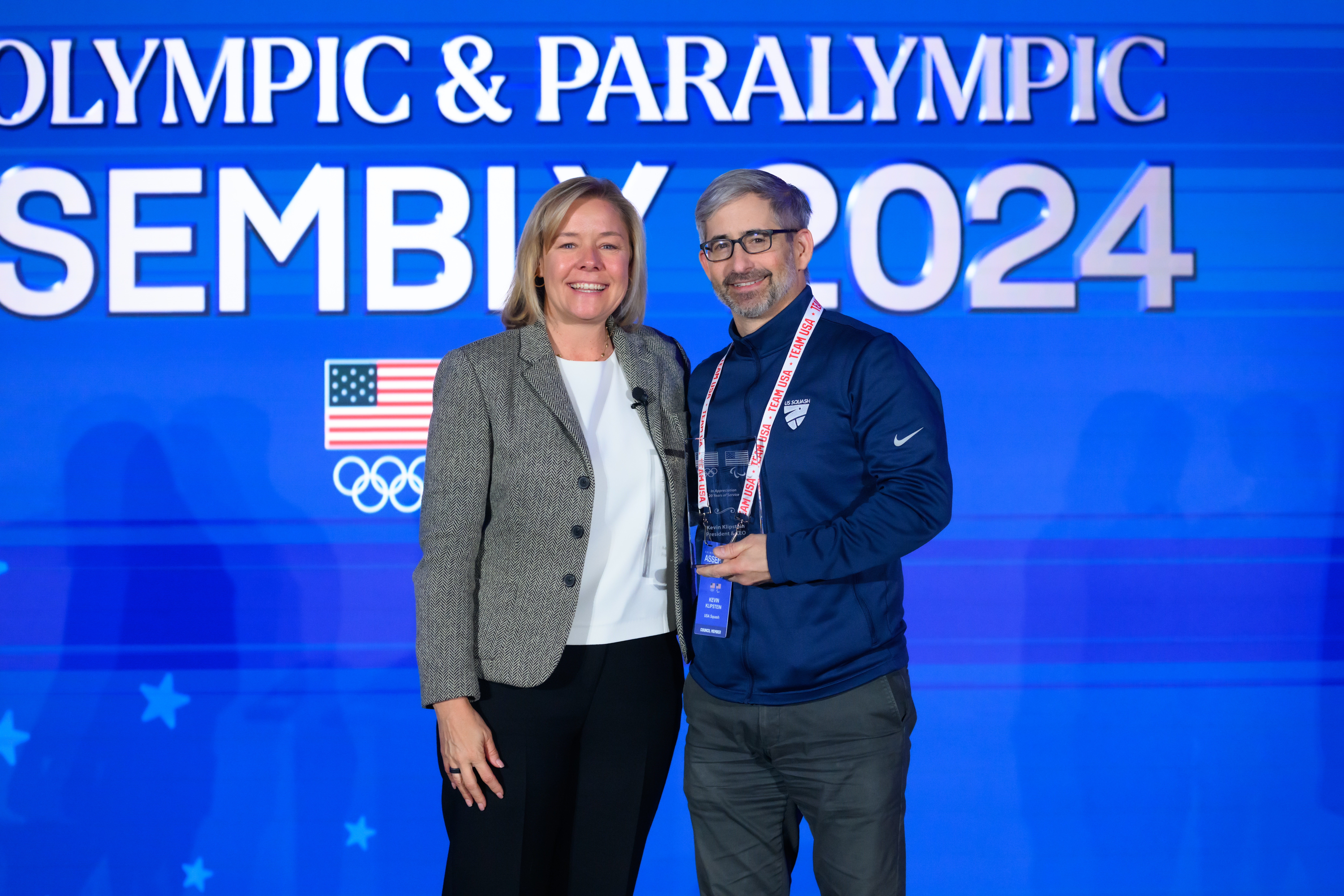
This winter, when a dozen leaders of the game were asked what words they’d use to describe Kevin Klipstein, they used the same key words: strategic, committed, diligent, intense, impactful, focused, determined. When the parade of athletes begins at the 2028 Games in Los Angeles and squash players finally walk into the stadium, there will be no one more responsible in the audience than Kevin Klipstein.
What do Eric Heiden, Big Bend National Park, Seattle’s Bumbershoot Festival and MLB.com have to do with each other? They are all part of the fascinating, roundabout squash journey of US Squash President & CEO Kevin Klipstein. Listen here to a penetrating and revealing conversation about parenting, sportsmanship and the first time he learned the importance of the T.